Slap Shot (1977) - If you talk to hockey players this is commonly listed as one of their favorite movies. It's also a movie that generates conversation. So let's get this out of the way right up front.
This is not a great movie. At the same time it is a great movie. In the same way that "Animal House" is not a great movie while still being a great movie. They are vulgar, irreverent and anti-establishment. And they are perfectly good with that. There's no pretense that they're trying to create art. Yet somehow they cross the line from common vulgar, irreverent crap to something that sticks with you. Suddenly vulgar, irreverent crap becomes...a great movie.
This is the story of the Charlestown Chiefs, a minor league hockey team in a small, dying steel mill town in Pennsylvania. To be honest the team stinks. It's has beens like player coach Reg Dunlop (Paul Newman) along with a whole lot never will bes. On top of that the team is about to be sold. The solution turns out to be three Hanson brothers picked up for next to nothing by the general manager (Strother Martin). The Hansons aren't very bright but they do one thing well. Fight. Dunlop turns them loose, the team starts to win and suddenly the arena is filled with fans. Along the way there are more decisions and trials to be overcome.
If you want a quick mental image of what this movie is like think "Major League" meets "Animal House". The story is utterly predictable (as most sports movies are), most of the characters are one dimensional and to be honest the script is pretty pedestrian. Yet somehow it takes that step into being a classic. Written by Nancy Dowd she draws heavily on the experience of her brother who played in the minor leagues. So it still reads true (witness the pro hockey players who are devoted to it). Add in some great individual lines (virtually all of which can not be repeated here), classic characters (the Hansons are legendary in hockey circles), and some fine direction from George Roy Hill and somehow it works. Newman says it was his favorite movie to work on.
And it looks like it was a lot of fun. Add in the pain of looking at mid-70s fashions and the old school hockey. If obscene language and a little nudity is a problem for you then you won't want to watch. But if you love sports and off the wall movie humor then you'll want to catch it.
It's not a great movie. But it's a great movie.
Rating - *** Worth A Look
Monday, June 10, 2013
Friday, June 7, 2013
Cheerios and Cowardice, Trailer Wars plus Sports and Media
"The View From the Phlipside" is a media commentary program airing on WRFA-LP, Jamestown NY. It can be heard Tuesday through Friday just after 8 AM and 5 PM. The following are scripts which may not exactly match the aired version of the program. Mostly because the host may suddenly choose to add or subtract words at a moments notice. WRFA-LP is not responsible for any such silliness or the opinions expressed. You can listen to a live stream of WRFA or find a podcast of this program at wrfalp.com. Copyright 2013 by Jay Phillippi. All Rights Reserved. You like what you see? Drop me a line and we can talk.
Program scripts from week of June 2, 2013
(My apologies for the long silence. Life has been...complicated)
My name is Jay Phillippi and I've spent my life in and around the media. TV, radio, the movies and more. I love them, and I hate them and I always have an opinion. Call this the View from the Phlipside.
Sports and Media
Time for one of my rare forays into the world of sports and media. And it all begins when a man loses his job. In this case the man in question is National Hockey League coach John Tortorella. Tortorella was, until recently, the man behind the bench for the New York Rangers.
Now on the surface it’s kind of hard to see why he lost his job. The Rangers were 171-115 and 29 in his time, made the playoffs 4 of 5 seasons he coached and finished first in their division just a year ago. Heck the Rangers signed him to a contract extension just a couple months ago. So apparently he’s not a terrible coach.
At least on the ice.
If you’re a hockey fan or a regular viewer of ESPN you have seen what the coach was bad at however. He gave awful media. Arrogant, dismissive, uncooperative, Tortorella made it clear that he’d rather be having the most unpleasant medical procedure you can imagine rather than talk to reporters.
The relationship between sports and media has changed immensely over the years. Once upon a time reporters considered covering up the personal shortcomings of the players just part of the job. More recently with 24 hour coverage the relationship has been often more antagonistic. The former Rangers coach isn’t the first sports coach to be, shall we say, less than forthcoming. New England Patriots coach Bill Belichick has made something of an art form of it. But Belichick manages to keep it at least civil. It’s more a mandatory social engagement with someone you don’t much like.
Here’s the reality. The old days are gone. Local coverage from print, radio and TV plus national coverage from the networks both broadcast and cable plus all the bloggers and vloggers are a part of the day to day life of athletes and coaches. You either need to figure out how to deal with them like a professional or find another profession.
I’m sure John Tortorella had some shortcomings as a coach on the ice. But my bet is that his shortcomings in the interview room are probably what cost him his job in the long run.
Trailer Wars
Interesting when you get two completely different groups of people to suddenly start saying the same thing at the same time. In my experience that’s when you need to start paying attention when they’re talking about you. In this case it’s the movie studios who need to sit up and pay a little attention. It’s not the movies themselves that are generating the conversation this time.
It’s the movie trailers.
Trailers are those movie previews that we watch before we get to what we actually paid to see. They’ve been around for decades. Like since 1913 when a short promo film for a musical called “The Pleasure Seekers” debuted in New York. They’re called “trailers” because orginally they were shown AFTER the movie. When they moved to their current postion shortly thereafter the name stuck.
So what’s the problem after all these years? How about the darn things have gotten too long? That’s the assessment of two different groups, the theater owners and the audience. A British research company called YouGov did a survey of audience members and found 49% said the trailers were too long and gave away too much of the movie. Meanwhile the theater owners think they’re just too long, period. With an average length these days of two and a half minute it just keeps pushing the start of the movie back and back and back. Which also annoys the audience. And there is no profit for the theater owners in an annoyed audience. Plus they’d like to limit the advance time for promotion to just four months. Right now you may be looking at teasers and trailers for movies that aren’t scheduled to be released until the summer of 2014.
You can certainly include me in the crowd that thinks these trailers are just too long and give away too much. At the same time I have to admit that the really bad movies are pretty obvious when you watch a long trailer. There’s just a feel to a trailer that has handed you every single funny moment in a bad movie. I kind of appreciate those I must admit.
At the same time I’m in the theater to see the movie I paid for, not something that’s coming in 10 months or to see a trailer that gives away any reason to pay for it when it does come out.
There’s a lot of conversation going on with people whose opinions count. Let’s hope the studios are listening.
Cheerios and Cowardice
I know the whole Cheerios TV ad has been analyzed to death. I doubt I have anything particularly new or exciting to add to the discussion. At the same time I think it’s one of those stories where every voice needs to be heard. We need to be clear that certain kinds of behavior just aren’t acceptable.
In case you missed it Cheerios is running an ad that involves a family of Mom, Dad and little girl. The little girl asks Mom about whether Cheerios are good for your heart like Daddy says. Mom basically agrees and little girl wanders off with the box of cereal. The last scene shows Dad with his chest covered in Cheerios. Cute. The source of the furor is that Mom is white and Dad is black. The immediate reaction in the comments section of YouTube was angry, abusive and overtly racist. While there was an outpouring of positive comments in reaction Cheerios wisely chose to turn off the comments and make them all go away.
Now let me be clear. I think the whole race-mixing, miscegenation argument needs to be consigned to the scrap heap of history. It’s the human race and it comes in different colors. I have no use for any other point of view. At the same time I defend our American belief in freedom of expression. The French author Voltaire said "I do not agree with what you have to say, but I'll defend to the death your right to say it." and I agree completely. But he also said “We have a natural right to make use of our pens as of our tongue, at our peril, risk and hazard.” And that’s where we may have lost the thread.
Freedom of expression does not mean that we can say whatever we want without fear of peril, risk and hazard. Our Founding Fathers knew it. That’s why the last line of the Declaration of Independence reads that they “mutually pledge to each other our Lives, our Fortunes, and our Sacred Honor,”. They accepted the risk in the words they said.
The problem with the Internet is that anonymity is taken as a right as well. Behind the cowardly mask of that anonymity things are said that dodge the risks and hazards. Those who exercise their bigotry under the flag of freedom of expression without being willing to take on the burden of those comments betray the very foundation of our country. As such they should be treated with the contempt that such behavior deserves.
Call that the View From the Phlipside
Wednesday, June 5, 2013
Movie Reviews - The Darjeeling Limited,
The Darjeeling Limited (2007) I'm pretty sure I've seen at least two other Wes Anderson movies that I liked - "Rushmore" and "The Royal Tennebaums". Both of which are unique and stylistic movies. What I remember working there doesn't seem to work here for me.
Anderson's directing becomes a part of the story, almost a character. It's an artificial, awkward, overly self conscious style that seems to get in the way of the story and characters. But then these are artificial, awkward and overly self conscious characters too. The direction comes off as just a bit too cute for my taste. It smacks of the director saying "See how clever I am". Spare me from clever directors.
It's the story of three brothers who come to India to try and find their family bond. They haven't seen one another for a year following the death of their father. Oldest brother Francis (Owen Wilson) is recovering from some kind of accident, middle brother Peter (Adrian Brody) is fleeing his insecurities about marriage and fatherhood and baby Jack (Jason Schwartzman) is worrying about an intense but strange relationship he has with a girlfriend (Natalie Portman). They eventually connect with their prodigal mother (Angelica Huston) who has joined a convent serving the poor of India. Bill Murray has a walk on role as a business man who misses a train.
The DVD begins with a short film called "The Hotel Chevalier" which takes a short, weird look at the relationship between Jack and his girlfriend. Don't ask me to make sense of it. The two characters are peculiar and unsympathetic and I just don't care about them or their self inflicted problems.
But then that's pretty much how I feel about all the characters and this movie. You're not going to learn much about them along the way and I doubt you're going to care too much about them either.
"There's so many things we don't know about each other". At the end of the movie you'll feel the same way.
Rating - ** Not Impressed
Anderson's directing becomes a part of the story, almost a character. It's an artificial, awkward, overly self conscious style that seems to get in the way of the story and characters. But then these are artificial, awkward and overly self conscious characters too. The direction comes off as just a bit too cute for my taste. It smacks of the director saying "See how clever I am". Spare me from clever directors.
It's the story of three brothers who come to India to try and find their family bond. They haven't seen one another for a year following the death of their father. Oldest brother Francis (Owen Wilson) is recovering from some kind of accident, middle brother Peter (Adrian Brody) is fleeing his insecurities about marriage and fatherhood and baby Jack (Jason Schwartzman) is worrying about an intense but strange relationship he has with a girlfriend (Natalie Portman). They eventually connect with their prodigal mother (Angelica Huston) who has joined a convent serving the poor of India. Bill Murray has a walk on role as a business man who misses a train.
The DVD begins with a short film called "The Hotel Chevalier" which takes a short, weird look at the relationship between Jack and his girlfriend. Don't ask me to make sense of it. The two characters are peculiar and unsympathetic and I just don't care about them or their self inflicted problems.
But then that's pretty much how I feel about all the characters and this movie. You're not going to learn much about them along the way and I doubt you're going to care too much about them either.
"There's so many things we don't know about each other". At the end of the movie you'll feel the same way.
Rating - ** Not Impressed
Wednesday, May 15, 2013
Book Review - The Men Who Lost America
The Men Who Lost America - British Leadership, the American Revolution, and the Fate of the Empire. By Andrew Jackson O'Shaughnessy
In school we all learned the American mythology of how we won our independence from Great Britain. It wasn't until I was in college that some of the detail of that part of our history was drawn into clearer focus. Too often the American victory is taken as inevitable. Us good, them bad, we win. As always the truth is much more nuanced than that.
The second level of understanding usually takes us to the "poor leadership" model. The military officers were second rate and the governmental leaders were fools. That's still a pretty simplistic look at what in fact is a complex and difficult piece of historical terrain.
Author O'Shaughnessy takes us to a whole new place (as Americans that is) and looks at the war from the point of view of those who lead it and opposed it on the British side. Ten pivotal people are examined and their roles dissected. The picture that emerges is fascinating. From King George III to his Prime Minster Lord North (who disliked the term Prime Minister, did not use it and asked repeatedly for years to be allowed to resign) to the commanders in the field (the brothers Howe, one a general the other an admiral, Burgoyne, Cornwallis and Rodney) the task they set before themselves never matched the reality that awaited in the colonies. The government was split on the subject of the war. As a result sometimes contradictory instructions were sent to the commanders. The Army chose repeatedly to use tactics seemingly designed to make their life hard. The use of German mercenaries was seen as an insult by those who saw this as a conflict among English peoples. Beyond that were the use of plunder and terror that simply stiffened the opposition. Add in the bits that we were taught - over extended supply lines, slow communication, byzantine administration and often enormous egos - and the situation was essentially unwinnable from the start.
Now on the American side there were similar problems. A weak central government that was essentially bankrupt, divided on the subject of the war and always capable of giving contradictory instruction to its generals. It was only because of the quality of the military leadership on BOTH sides that this war went on as long as it did. The political leadership in England remained in some quarters astoundingly tone deaf to what was actually happening in America. Some of them, including the King, wanted to continue on fighting even after Cornwallis's surrender.
Beyond the fine story telling and wonderful insight that O'Shaughnessy brings to the story I was struck by the parallels to modern American history. Now we are the world power attempting to bring order to the world through military might. Too often it seems we are as tone deaf to the reality of the situations in those countries where we have been fighting for a decade as King George III was. His book stands as a stern warning of what may lie before us is we insist on following that path.
For the history lover this is a great book. I would expect that those dedicated to the history of the War of Independence will classify this one as a must have.
"The Men Who Lost America" will hit bookshelves on June 28, 2013.
Rating - **** Recommended
In school we all learned the American mythology of how we won our independence from Great Britain. It wasn't until I was in college that some of the detail of that part of our history was drawn into clearer focus. Too often the American victory is taken as inevitable. Us good, them bad, we win. As always the truth is much more nuanced than that.
The second level of understanding usually takes us to the "poor leadership" model. The military officers were second rate and the governmental leaders were fools. That's still a pretty simplistic look at what in fact is a complex and difficult piece of historical terrain.
Author O'Shaughnessy takes us to a whole new place (as Americans that is) and looks at the war from the point of view of those who lead it and opposed it on the British side. Ten pivotal people are examined and their roles dissected. The picture that emerges is fascinating. From King George III to his Prime Minster Lord North (who disliked the term Prime Minister, did not use it and asked repeatedly for years to be allowed to resign) to the commanders in the field (the brothers Howe, one a general the other an admiral, Burgoyne, Cornwallis and Rodney) the task they set before themselves never matched the reality that awaited in the colonies. The government was split on the subject of the war. As a result sometimes contradictory instructions were sent to the commanders. The Army chose repeatedly to use tactics seemingly designed to make their life hard. The use of German mercenaries was seen as an insult by those who saw this as a conflict among English peoples. Beyond that were the use of plunder and terror that simply stiffened the opposition. Add in the bits that we were taught - over extended supply lines, slow communication, byzantine administration and often enormous egos - and the situation was essentially unwinnable from the start.
Now on the American side there were similar problems. A weak central government that was essentially bankrupt, divided on the subject of the war and always capable of giving contradictory instruction to its generals. It was only because of the quality of the military leadership on BOTH sides that this war went on as long as it did. The political leadership in England remained in some quarters astoundingly tone deaf to what was actually happening in America. Some of them, including the King, wanted to continue on fighting even after Cornwallis's surrender.
Beyond the fine story telling and wonderful insight that O'Shaughnessy brings to the story I was struck by the parallels to modern American history. Now we are the world power attempting to bring order to the world through military might. Too often it seems we are as tone deaf to the reality of the situations in those countries where we have been fighting for a decade as King George III was. His book stands as a stern warning of what may lie before us is we insist on following that path.
For the history lover this is a great book. I would expect that those dedicated to the history of the War of Independence will classify this one as a must have.
"The Men Who Lost America" will hit bookshelves on June 28, 2013.
Rating - **** Recommended
Monday, May 13, 2013
Movie Reviews - Panic and Shane
Panic (2000) - As the credits roll I'm thinking "How have I never heard of this movie?" William H. Macy, Tracy Ullman, John Ritter, Neve Campbell, Donald Sutherland, Barbara Bain. Miguel Sandoval even has a short little role towards the end. A classic spot the stars and yet I've never heard of it. Turns out it was originally an made for HBO movie that was then released to theaters. It didn't make a lot money there. Which is too bad really.
Alex (Macy) is a hit man in the family hit man business but it's begun to weigh on his spirit. So he goes to see a psychologist (Ritter). In the waiting room he meets a challenging, fascinating 23 year old named Sarah (Campbell) who suddenly gives his life a jolt. His parents (Sutherland and Bain) are doing their best to run his life which is not a good thing given that they are unpleasant people. Meanwhile his wife (Ullman) is just trying to understand. When his next hit turns out to be his shrink things begin to spin out of control.
This is exactly the kind of movie I expect Macy to star in and it's why he is on my list of actors I'll go out of my way to watch. Here he is surrounded with wonderful actors reveling in sharp, fun roles. Campbell is amazing as the object of Alex's obsession. She's sexy and self assured while still being vulnerable and fragile. Ullman offers up an astoundingly subtle and understated performance as his wife. Sutherland and Bain do what they've done for decades, crank out another perfect little gem of a performance. Same goes for Ritter. All of them are upstaged by the brief scenes with Alex's son Sammy played by David Dorfman. He is just beyond cute in his film debut as he runs circles around his father. It's written and directed by Henry Bromell a man with a long track record in television.
I want to call it a black comedy. The relationship between father and son grows ever darker while the one between Alex and Sarah bops along to it's own quirky beat. The movie loses the thread of it's humor about half way through and morphs into a quiet little drama. On the whole it's an outstanding little movie.
Rating - **** Recommended
Shane (1953) - Here's one of the great classic Westerns (#3 on the AFI list). The story of a world weary gun fighter named Shane (Alan Ladd) who hooks up with a family of Wyoming homesteaders Joe, Marian and Joey Starrett (Van Heflin, Jean Arthur and Brandon De Wilde). He discovers that there's a range war beginning led by the local cattle baron Ryker (Emile Meyer) and he's drawn into the intrigue when Ryker brings in a hired gun (Jack Palance). It's a classic confrontation between open range cattle men and the farmers who came behind.
Director George Stevens creates his masterwork with this one. Visually this is gorgeous. The Grand Tetons serve as background and the wide open sky of the west frame everything. Cinematographer Loyal Griggs won an Oscar for his work (the movie picked up 5 other nominations including for Director, Picture, Screenplay plus Supporting nods for Palance and De Wilde). Add in a supporting cast with some great folks (Ellen Corby, Edgar Buchanan, Elisha Cook Jr) and you have all the ingredients of a wonderful movie. Stevens goes one step farther and pays attention to every detail. The clothes (costumes by Edith Head), the buildings, right down to making sure there was enough weight in a coffin to be realistic. The final result is something that offers some startling realism combined with typical Hollywood polish. This was Arthur's last movie (she came out of retirement as a favor to Stevens) and De Wilde does a star turn in the role of the son. Add in an iconic line ("Shane, Shane, come back!") and an equally iconic Hollywood ending and a wonderful movie movies into the classic field.
If I have a complaint to make it's the silly story line that shows up in so many westerns. The farmer's wife who falls head over heels for the stranger who rides into their lives. It inevitably happens the moment, the MOMENT, she first lays on him. Guess my opinion of the ladies is a little higher than that.
On the list of classic Westerns I'd take this one over "Rio Bravo" any day.
Rating - **** Recommended
Alex (Macy) is a hit man in the family hit man business but it's begun to weigh on his spirit. So he goes to see a psychologist (Ritter). In the waiting room he meets a challenging, fascinating 23 year old named Sarah (Campbell) who suddenly gives his life a jolt. His parents (Sutherland and Bain) are doing their best to run his life which is not a good thing given that they are unpleasant people. Meanwhile his wife (Ullman) is just trying to understand. When his next hit turns out to be his shrink things begin to spin out of control.
This is exactly the kind of movie I expect Macy to star in and it's why he is on my list of actors I'll go out of my way to watch. Here he is surrounded with wonderful actors reveling in sharp, fun roles. Campbell is amazing as the object of Alex's obsession. She's sexy and self assured while still being vulnerable and fragile. Ullman offers up an astoundingly subtle and understated performance as his wife. Sutherland and Bain do what they've done for decades, crank out another perfect little gem of a performance. Same goes for Ritter. All of them are upstaged by the brief scenes with Alex's son Sammy played by David Dorfman. He is just beyond cute in his film debut as he runs circles around his father. It's written and directed by Henry Bromell a man with a long track record in television.
I want to call it a black comedy. The relationship between father and son grows ever darker while the one between Alex and Sarah bops along to it's own quirky beat. The movie loses the thread of it's humor about half way through and morphs into a quiet little drama. On the whole it's an outstanding little movie.
Rating - **** Recommended
Shane (1953) - Here's one of the great classic Westerns (#3 on the AFI list). The story of a world weary gun fighter named Shane (Alan Ladd) who hooks up with a family of Wyoming homesteaders Joe, Marian and Joey Starrett (Van Heflin, Jean Arthur and Brandon De Wilde). He discovers that there's a range war beginning led by the local cattle baron Ryker (Emile Meyer) and he's drawn into the intrigue when Ryker brings in a hired gun (Jack Palance). It's a classic confrontation between open range cattle men and the farmers who came behind.
Director George Stevens creates his masterwork with this one. Visually this is gorgeous. The Grand Tetons serve as background and the wide open sky of the west frame everything. Cinematographer Loyal Griggs won an Oscar for his work (the movie picked up 5 other nominations including for Director, Picture, Screenplay plus Supporting nods for Palance and De Wilde). Add in a supporting cast with some great folks (Ellen Corby, Edgar Buchanan, Elisha Cook Jr) and you have all the ingredients of a wonderful movie. Stevens goes one step farther and pays attention to every detail. The clothes (costumes by Edith Head), the buildings, right down to making sure there was enough weight in a coffin to be realistic. The final result is something that offers some startling realism combined with typical Hollywood polish. This was Arthur's last movie (she came out of retirement as a favor to Stevens) and De Wilde does a star turn in the role of the son. Add in an iconic line ("Shane, Shane, come back!") and an equally iconic Hollywood ending and a wonderful movie movies into the classic field.
If I have a complaint to make it's the silly story line that shows up in so many westerns. The farmer's wife who falls head over heels for the stranger who rides into their lives. It inevitably happens the moment, the MOMENT, she first lays on him. Guess my opinion of the ladies is a little higher than that.
On the list of classic Westerns I'd take this one over "Rio Bravo" any day.
Rating - **** Recommended
Saturday, May 11, 2013
Rap and History, Bad Television and Car Ads
"The View From the Phlipside" is a media commentary program airing on WRFA-LP, Jamestown NY. It can be heard Tuesday through Friday just after 8 AM and 5 PM. The following are scripts which may not exactly match the aired version of the program. Mostly because the host may suddenly choose to add or subtract words at a moments notice. WRFA-LP is not responsible for any such silliness or the opinions expressed. You can listen to a live stream of WRFA or find a podcast of this program at wrfalp.com. Copyright 2013 by Jay Phillippi. All Rights Reserved. You like what you see? Drop me a line and we can talk.
Program scripts from week of May 6, 2013
My name is Jay Phillippi and I've spent my life in and around the media. TV, radio, the movies and more. I love them, and I hate them and I always have an opinion. Call this the View from the Phlipside.
Thinking About Rap and History
Thinking About Bad Television
Crisis Management
All I can say is What Were You Thinking?
Call that the View From the Phlipside
Program scripts from week of May 6, 2013
My name is Jay Phillippi and I've spent my life in and around the media. TV, radio, the movies and more. I love them, and I hate them and I always have an opinion. Call this the View from the Phlipside.
Thinking About Rap and History
It’s our first ever theme week here at View From the Phlipside. All our shows this week will center on the same theme. And theme for this inaugural theme week is - WHAT Were You Thinking?
For this installment I needed to do a little research. That’s because the story revolves around the rap star known as Lil Wayne. Now Li’l Wayne is not on my regular music playlist (you’re stunned I know) so I needed to get a little background. What I discovered is gold and platinum selling albums, Grammy Award and that he has passed no less than Elvis Presley for the most entries on the Billboard Hot 100 Singles list. I may not know his music but this guy has to be credited as a Big Star.
Yet somehow this big star doesn’t seem to have anyone around him that can help him with some “think first, speak second” type details. I keep wondering in all these stories where the legal department has been keeping itself.
In L’il Wayne’s case it involves the lyrics he contributed to a song by fellow rapper Future called “Karate Chop”. In them the big star makes a very uncool reference to the beating death of civil right’s martyr Emmitt Till. The Till Foundation took great exception and Pepsi has yanked an endorsement deal. (Now Pepsi has it’s own What Were You Thinking problem with an online ad that plays to racial stereotypes which they’ve yanked as well. It’s like there’s something in air). The rapper’s first attempt to “fix” things went awry when his apology never actually got around to, you know, apologizing. He felt their pain and promised never to do it again. But the whole “I was wrong and I’m sorry” never quite made it into the letter.
It’s just astounding. I’m pretty sure Li’l Wayne has a manager slash agent slash legal counsel. He can certainly afford one. I’m also assuming that his record label has folks who do the legal eagle stuff as well. I mean there are a LOT of lawyers in this country.
The fact that no one in that process ever said “Um, Emmett Till is kind of a major historical figure and this is EXACTLY the wrong way to be mentioning him. Maybe we ought to try something else” just astounds me.
Thinking About Bad Television
I talk to people virtually every week who just despair over the state of television programming in this country. They look out over the hundreds of channels available to us today and see nothing but mindless drivel. What isn’t mindless is actively making you stupider. It’s so depressing.
Well at least until you start looking at TV offerings from elsewhere in the world. For today’s installment of our theme I direct your attention to Denmark. Now as a general rule I have a pretty positive impression of Denmark. Never been there, don’t know much about it but it seems pretty OK. At the same time they let the program “Blachman” slide through the programming approval process to hit the airwaves.
I’m not even sure how to describe this show. It’s named for it’s host and creator Thomas Blachman. The show consists of Blachman and a guest doing...commentary. OK this is where it gets awkward. A young woman comes out on stage dressed in a silky robe. Once she’s standing in front of the two men she drops her robe. Which, it turns out, is the only thing she was wearing. Blachman and guest then do commentary on her body. That’s the whole the show. Two guys offering their opinions on a naked woman.
The reaction has been pretty much what you’d expect. Outrage. Petitions. Angry phone calls. Social media going berserk. In the middle of it all we find Thomas Blachman.
Who claims he doesn’t understand why everyone is so upset. My two favorite quotes from him are “Ungratefulness is the only thing that can really wear down the few geniuses who reside in our country. “ And yes he’s talking about himself there. Worse yet it appears he actually lives here in New York state. And this about the show’s concept “The female body thirsts for words. The words of a man”
Mr Blachman? I think there are a few women here who have a few words for you.
Crisis Management
In this installment we look at the advertising agencies for a variety of automobile manufacturers. Normally my biggest complaint with car ads is that they’re boring. Long spiels about the wonderful technical specifications that most people don’t really understand or pitches that buying this car will make you attractive to members of the opposite sex or shots of the car driving MUCH faster than you will ever have the opportunity or honestly, the desire.
So maybe what happened here is that the folks on the creative teams are just as bored with it all as I am. That would be the only rational explanation. Otherwise, they’ve just lost their minds.
First there was the General Motors ad proposal that showed former Italian Prime Minister Silvio Berlusconi driving a car with a trunk full of bound and gagged young women. Given the charges facing Signor Berlusconi it’s probably best that the ad was never intended to actually be used. Sadly someone decided to share it anyway and the creative team behind it all lost their jobs.
So you probably think that the ad folks working for GM will have learned their lesson and stick to the safe and boring road. You don’t know many creative people, do you? The latest gaffe involves a kind of 1930’s retro look spot that features a song that makes some very out dated racist statements about Chinese people. That would be bad enough until you discover that it was running worldwide including parts of China. Nice.
But it is Hyundai that is the real head scratcher. Someone greenlighted an ad that is trying to tout the green qualities of the new ix35. Only water vapor comes out of the exhaust pipe. So what did they go for? A man failing to commit suicide by breathing that exhaust. I am absolutely serious. A whole bunch of someones looked at that ad and said “Looks great to me”.
All I can say is What Were You Thinking?
Call that the View From the Phlipside
Wednesday, May 8, 2013
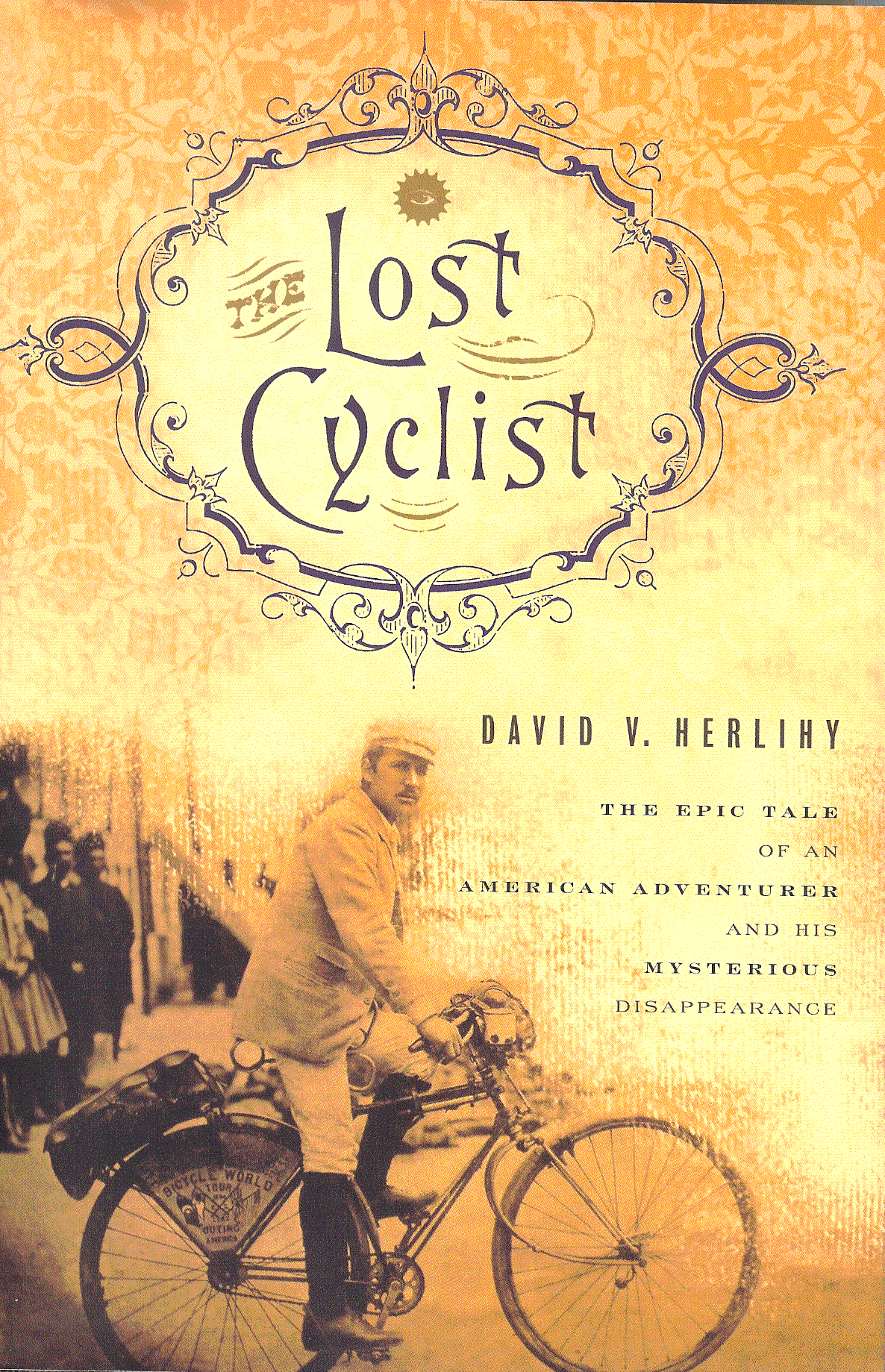
Book Review - The Lost Cyclist
The Lost Cyclist - David V. Herlihy (2010) - The sub-title here is "The Epic Tale Of An American Adventurer And His Mysterious Disappearance" which offers a nice little summation.
This is the story of Frank Lenz an early star in the world of bicycling. Bicycles are such a common object that we forget that once there was a time when they were new. In the late 1800's bicycles were the rage. Starting with the challenging "ordinary"or "Pennyfarthing" then moving to the "safety", which is the origin of the bicycle most of us know today, bicycling was a craze in America and Europe. Out of Pittsburgh, PA came several of the best of the early riders including Lenz. His specialty was long distance riding or touring. While he had great success on the ordinary Lenz was always running second to his rivals and he wanted more than that. He found it in the innovative new safety bike with it's pneumatic tires (previously bike tires had been solid rubber. The inflatable tire was a huge step up in comfort and ease of riding). What he really needed was a momentous ride.
The ride he chose was to go around the world on his bike. Beginning in the States he would travel west to Japan, then China and across Asia finally to Europe and home. Others had done similar trips but never this direction and never with the intent to ride the entire way. Previous riders had covered long sections of the trip by train which Lenz refused to do. The Pittsburgh native would make it as far as Turkey and then never be heard from again. To this day a mystery surrounds the end of the trip.
Herlihy covers the challenges and trials of the trip with a story teller's skill. From Lenz's early days in racing and touring through the many challenges that would face him before he even made it to Turkey the author draws you into the tale. The rider is often his own worst enemy while at the same time his courage and incredible physical determination take him past obstacles that would have balked any ordinary person. The story follows right through the investigation launched into his death and the roadblocks that impede it.
And Lenz himself is often the greatest challenge on the trip. Like many of his time he assumes a natural superiority over anyone who isn't like him. There is an ingrained racism in American culture that is right at the surface in those days. Add in the strong element of cultural superiority that was at its height at this point in American history and Lenz is bound to create ill will among those with narrower world views and/or longer histories than our own. It seems quite possible that he crossed the wrong person at the wrong time resulting in his death.
If you love well written history you should enjoy this. If you're a cyclist (or wheel man as we were referred to back in the day) with a love of history this one should definitely be on your list.
Rating - **** Recommended
This is the story of Frank Lenz an early star in the world of bicycling. Bicycles are such a common object that we forget that once there was a time when they were new. In the late 1800's bicycles were the rage. Starting with the challenging "ordinary"or "Pennyfarthing" then moving to the "safety", which is the origin of the bicycle most of us know today, bicycling was a craze in America and Europe. Out of Pittsburgh, PA came several of the best of the early riders including Lenz. His specialty was long distance riding or touring. While he had great success on the ordinary Lenz was always running second to his rivals and he wanted more than that. He found it in the innovative new safety bike with it's pneumatic tires (previously bike tires had been solid rubber. The inflatable tire was a huge step up in comfort and ease of riding). What he really needed was a momentous ride.
The ride he chose was to go around the world on his bike. Beginning in the States he would travel west to Japan, then China and across Asia finally to Europe and home. Others had done similar trips but never this direction and never with the intent to ride the entire way. Previous riders had covered long sections of the trip by train which Lenz refused to do. The Pittsburgh native would make it as far as Turkey and then never be heard from again. To this day a mystery surrounds the end of the trip.
Herlihy covers the challenges and trials of the trip with a story teller's skill. From Lenz's early days in racing and touring through the many challenges that would face him before he even made it to Turkey the author draws you into the tale. The rider is often his own worst enemy while at the same time his courage and incredible physical determination take him past obstacles that would have balked any ordinary person. The story follows right through the investigation launched into his death and the roadblocks that impede it.
And Lenz himself is often the greatest challenge on the trip. Like many of his time he assumes a natural superiority over anyone who isn't like him. There is an ingrained racism in American culture that is right at the surface in those days. Add in the strong element of cultural superiority that was at its height at this point in American history and Lenz is bound to create ill will among those with narrower world views and/or longer histories than our own. It seems quite possible that he crossed the wrong person at the wrong time resulting in his death.
If you love well written history you should enjoy this. If you're a cyclist (or wheel man as we were referred to back in the day) with a love of history this one should definitely be on your list.
Rating - **** Recommended
Subscribe to:
Posts (Atom)